

Piston Pin Design & Fit
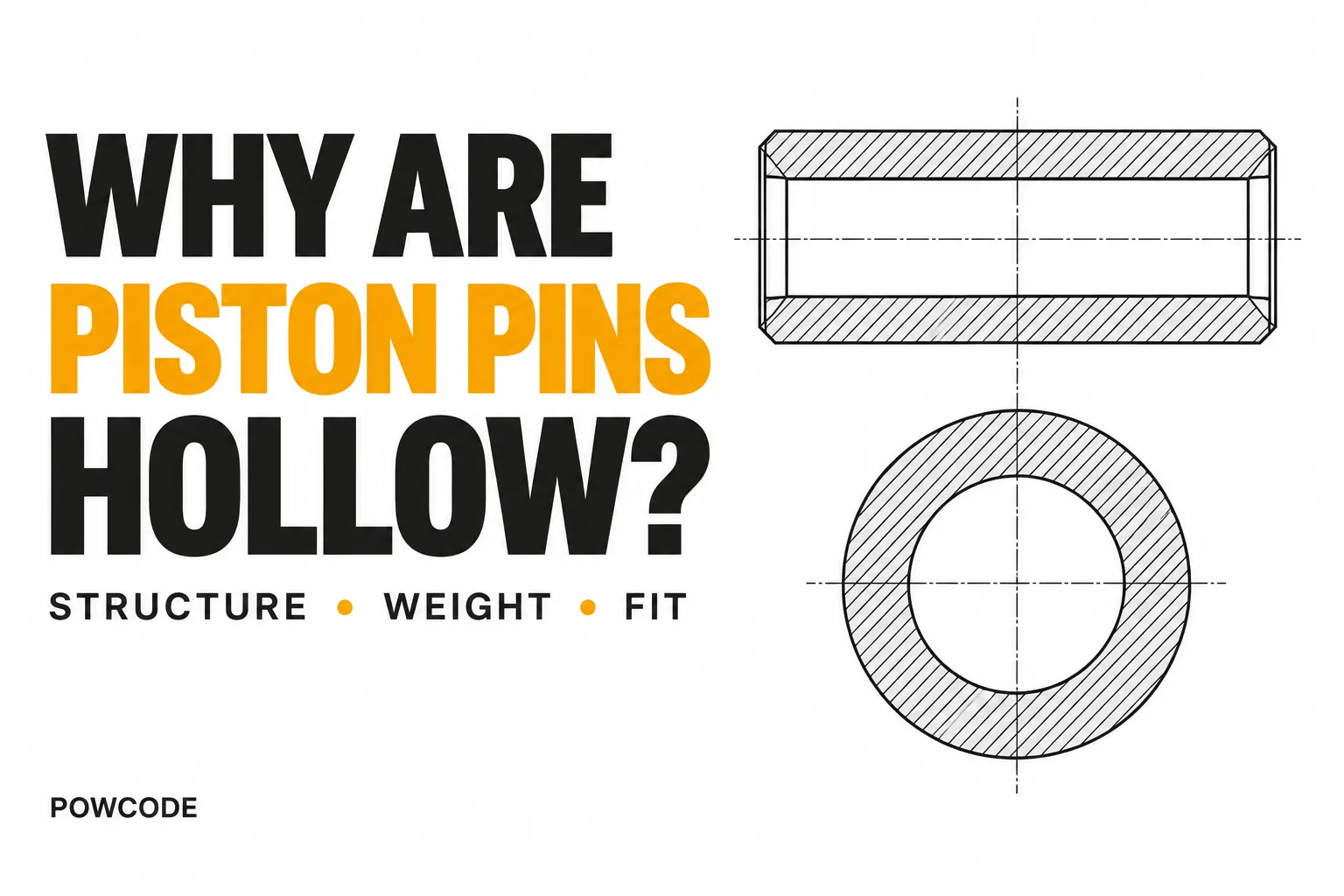
Why remove the centre of a piston pin? A solid steel pin may look stronger, but an engine component cannot be judged by the amount of material alone. The pin accelerates, decelerates and changes direction with the piston, so its mass also contributes to inertia loads.
A hollow section takes advantage of a geometric property: material farther from the centre contributes more to bending stiffness. Removing some central material reduces mass while retaining much of that stiffness. However, increasing the bore reduces wall thickness, making deformation and fatigue important design considerations.
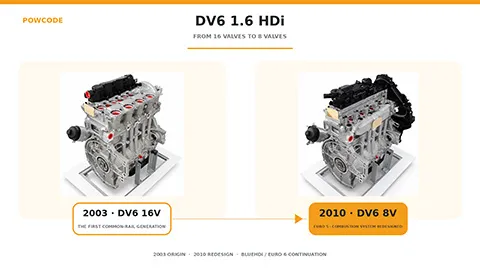
These design and fit considerations apply to piston pins in both DV6 8V and DV6 16V assemblies. Two pins with the same outside diameter and length are not automatically interchangeable: bore geometry, material, dimensional tolerances and the fit with the piston and connecting rod all affect their working conditions. The examples below compare specific catalogue applications within the DV6 family.
How much bending stiffness is lost when the centre is removed?
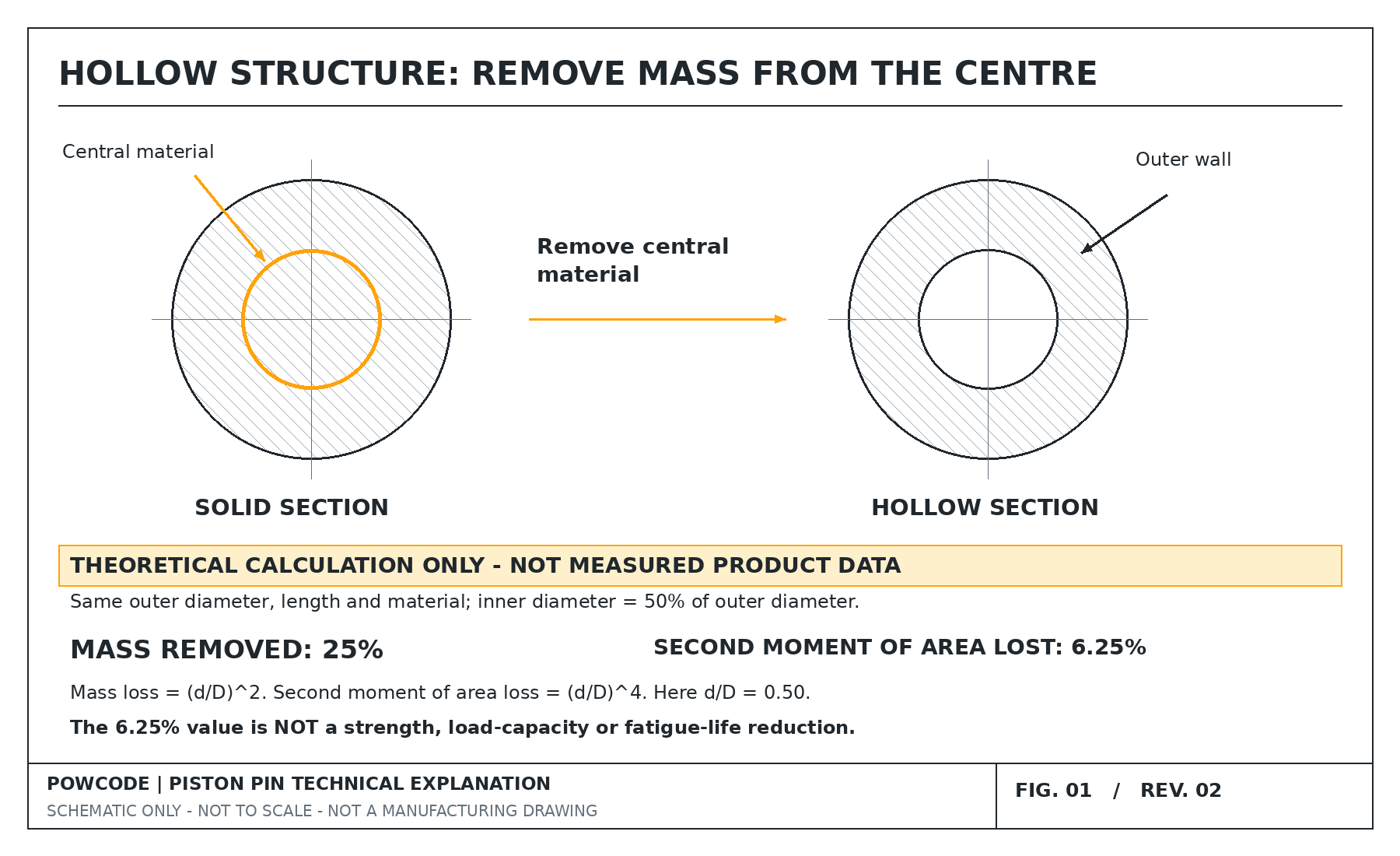
A uniform cylindrical model helps explain the geometry. For outside diameter D and inside diameter d, the cross-sectional area A and second moment of area I are:
A = π(D² − d²) / 4
I = π(D⁴ − d⁴) / 64
For the same material and length, cross-sectional area determines mass. The second moment of area is the geometric parameter used to calculate bending stiffness. Area depends on diameter squared, whereas I depends on diameter to the fourth power. Removing central material therefore does not reduce mass and bending stiffness by the same proportion.
For example, assume the inside diameter is 50% of the outside diameter, with the same outside diameter, length and material as a solid cylinder. The calculated mass reduction is 25%, while I decreases by 6.25%. With the same elastic modulus E, bending stiffness EI also decreases by 6.25%.
These percentages are theoretical calculations, not measurements of a DV6 piston pin or an original equipment weight-reduction specification. A 6.25% reduction in I does not mean that strength, load capacity or fatigue life decreases by only 6.25%. Those properties also depend on contact loads, deformation and local stresses.
Why not make the bore as large as possible?
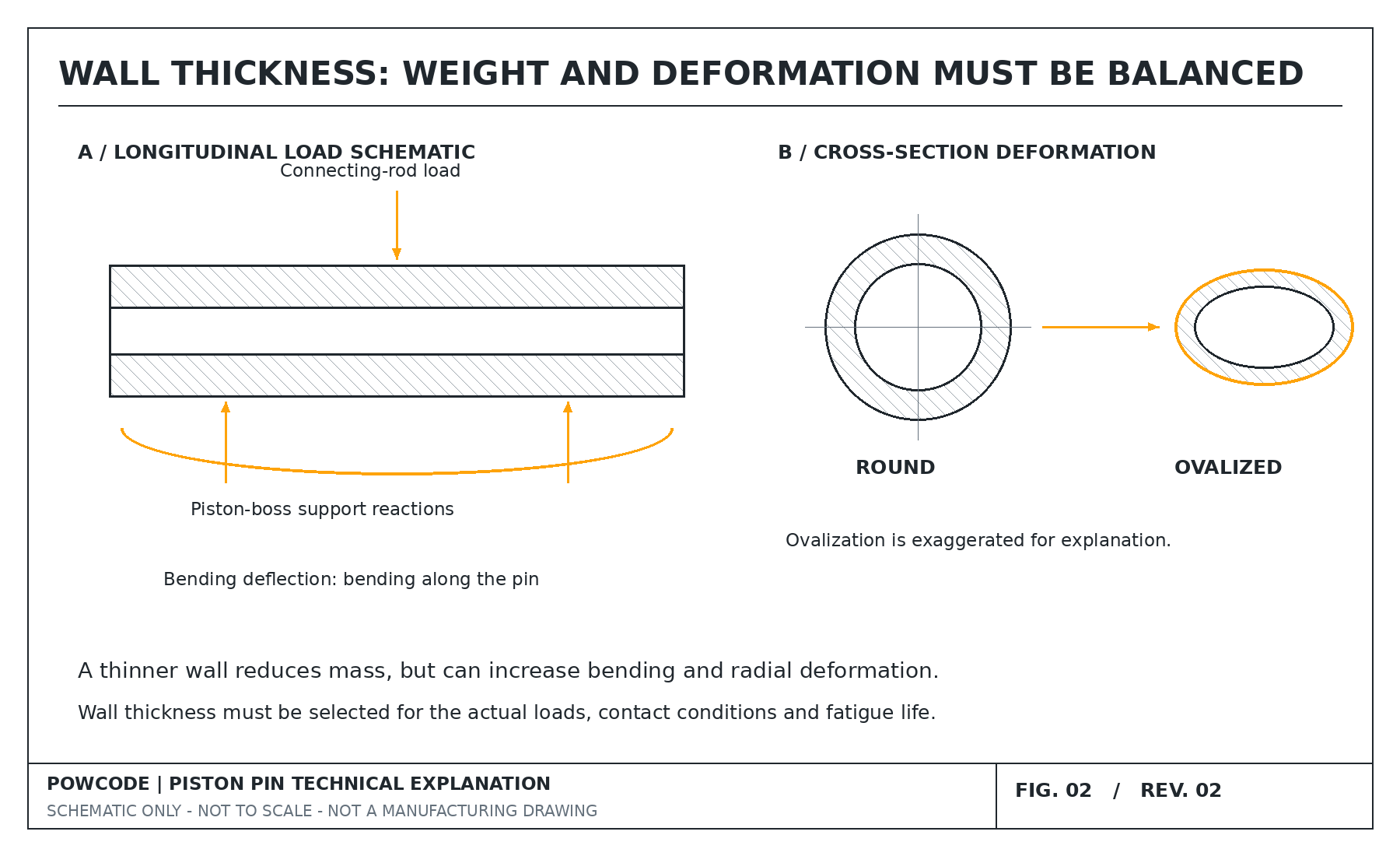
During operation, the connecting-rod small end applies load around the middle of the pin, while the piston pin bosses support it on either side. The pin bends along its length, and local contact loads can also deform its circular section into an oval. Wall thickness affects both forms of deformation.
Piston-pin failure analysis considers geometry, bending, ovalisation, contact pressure and initial clearance together.[2] The second moment of area alone cannot determine a suitable bore diameter for a particular pin.
A thinner wall can reduce mass further, but it may also increase deformation and alter the pressure distribution between the pin, piston bosses and connecting-rod small end. Wall thickness must suit the engine loads and the mating components.
The bore is not necessarily a straight, constant-diameter hole. ISO 18669-1 includes cylindrical, centre-reinforced and tapered bore designs.[1] Different profiles change the wall-thickness distribution along the pin, but their suitability still depends on support positions, operating conditions and manufacturing requirements.
Why does piston-pin mass matter?
The piston pin forms part of the reciprocating assembly. At the same acceleration, inertia force is proportional to mass: F = ma. Reducing pin mass reduces the associated inertia load transmitted through the connecting rod under the same motion conditions.
In SAE Technical Paper 2015-01-0523, MAHLE engineers report that piston pins can account for approximately 10–30% of reciprocating mass, depending on the engine application. Their composite design combines a steel sleeve with an aluminium core, with reported weight reductions of up to approximately 20% for gasoline engines and 30% for passenger-car diesel engines.[3]
This research demonstrates the engineering interest in lighter piston pins. However, the composite pin is a different design from a conventional hollow steel pin. Its reported weight reductions must not be applied directly to the hollow-section example above.
Piston pins are commonly manufactured from steel.[6] A hollow design balances reciprocating mass against load requirements. The specific material grade and heat-treatment requirements should be taken from the technical specification for the relevant product.
Piston material and piston-pin material are different specifications
POWCODE specifies AC8A aluminium alloy for the pistons shown on its DV6 8V engine parts platform. AC8A refers to the piston body, not the piston pin. For both DV6 8V and 16V applications, the piston-pin steel grade and heat treatment must be confirmed from the specification for the supplied pin; they cannot be inferred from the piston alloy. The AC8A specification cited here applies to the listed POWCODE 8V piston and should not be extended to every DV6 16V piston.
The same outside dimensions do not guarantee the same fit
Product catalogues usually list piston-pin diameter and length. These dimensions help identify a component, but they do not define its full engineering specification. Bore profile, wall thickness, actual mass, material, heat treatment and dimensional tolerances also need to be checked.
For a clearance-fit interface, diametral clearance equals the actual bore diameter minus the actual pin diameter. When the pin and bore are concentric, radial clearance on each side is half the diametral clearance. This is a calculation relationship, not an acceptable-clearance specification for any engine.
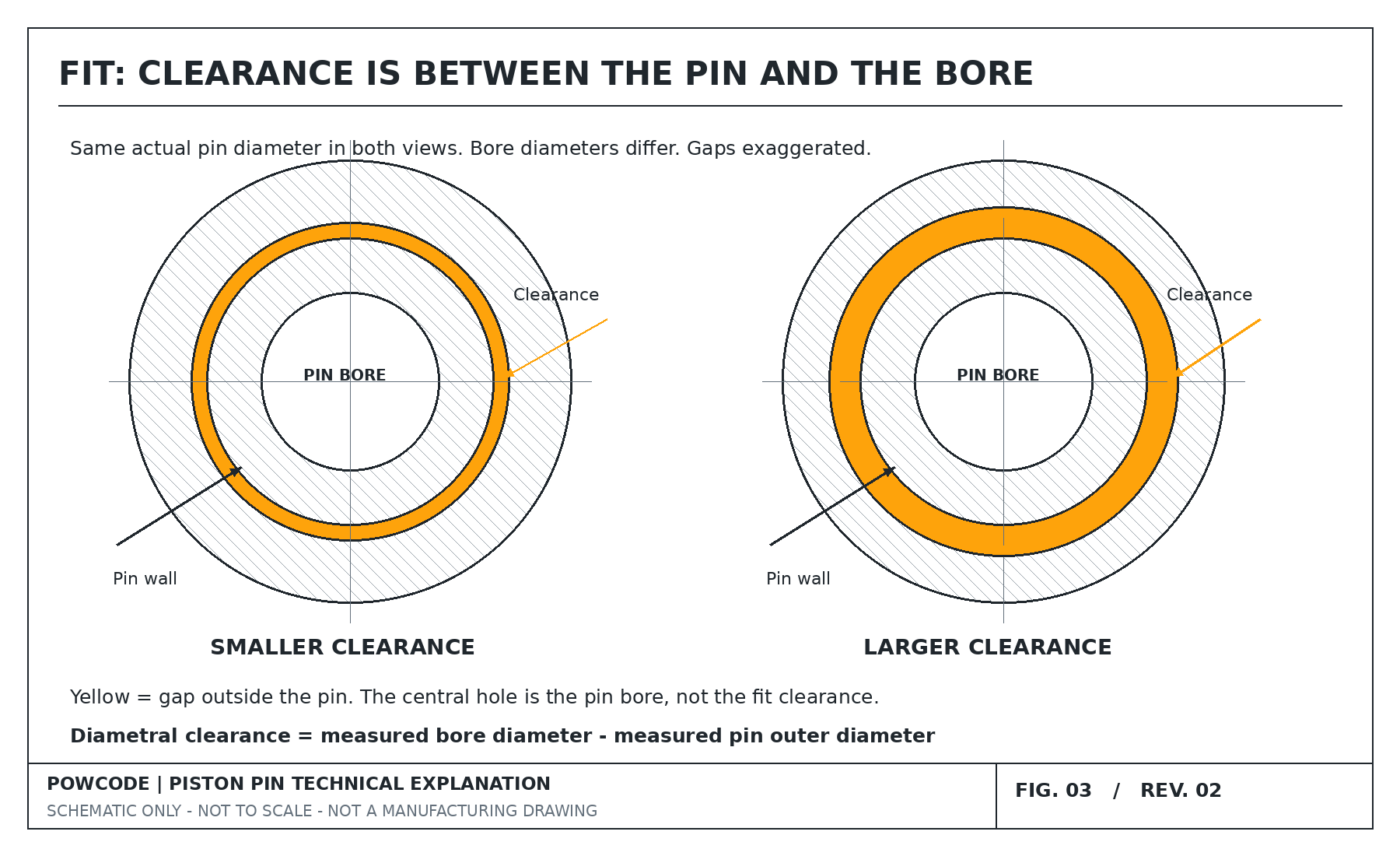
A larger pin diameter or smaller bore reduces clearance; the opposite increases it. Measurement temperature, measurement position and form errors also affect the assessment. Retention methods differ between engines and interfaces, so a single clearance value cannot be applied universally.
During engine-component development, POWCODE has purchased piston assemblies and related samples from different sources for physical comparison. This experience has drawn our attention to material specifications and fit requirements beyond catalogue dimensions. Sample comparisons help identify questions for further investigation, but they do not replace material testing, production-batch statistics or engine durability validation.
DV6 8V and 16V: what does a 26 × 61 mm pin tell us?
The DV6 family provides a useful comparison between 8V and 16V piston assemblies. The cited catalogue lists the DV6C piston 87-72772-STD with a 26 × 61 mm pin, a 41.750 mm compression height and a 45.000 mm combustion-bowl diameter. For the earlier DV6 TD / TED application, piston 87-71783-STD also has a 26 × 61 mm pin, but its listed compression height is 41.700 mm and its combustion-bowl diameter is 41.800 mm. Both catalogue entries specify a 75 mm cylinder bore.[4–5]
The same nominal pin dimensions can therefore appear in different piston designs. The catalogue comparison supports the stated dimensions for these two applications; it does not establish that every DV6 8V or 16V piston uses the same pin. Matching diameter and length also leaves bore geometry, mass, heat treatment and manufacturing tolerances unconfirmed. To assess a replacement across versions, check the pin specification, piston and connecting-rod references, retention arrangement and mating dimensions together.
When selecting parts for DV6 8V or 16V, identify the engine version and original piston assembly before comparing pin dimensions. The POWCODE DV6 8V engine parts platform provides an overview of 8V pistons, piston pins, circlips and connecting rods. For DV6 16V requirements or a proposed cross-version replacement, send POWCODE the engine code, OE reference and photographs of the original components for a specification check.
What else should be checked when selecting a piston pin?
Hollow geometry explains how a pin can save weight, but selection must return to the specific component. Outside diameter and length are the starting point. Tolerances, bore geometry, material, heat treatment and the piston-side and connecting-rod-side fit requirements all need supporting specifications.
When comparing two pins of the same outside dimensions, weight or wall thickness alone does not establish which is suitable. Confirm their intended applications and fit arrangements before assessing whether there is evidence for substitution.
Find DV6 8V and 16V Piston Components
For DV6 8V applications, review the 8V piston and related parts listings and add the required items to your enquiry list. For DV6 16V applications, contact POWCODE with your engine code, OE reference and clear photographs of the original piston and pin. These details help us check the required specification and supply scope. Confirm separately whether the quoted piston assembly includes the pin, rings and circlips.