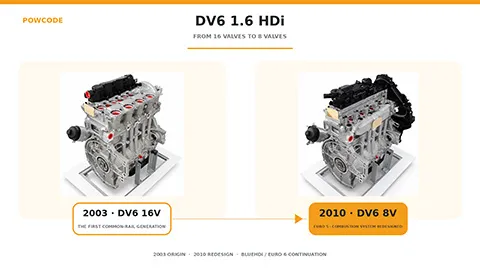


Will new piston rings restore an engine's sealing? If the top-ring groove is worn, even a new ring may fail to seat correctly. For DV6 8V and 16V piston assemblies fitted with a keystone top ring, repair and parts selection require the ring and its groove to be assessed together.
The keystone profile helps the ring remain mobile in the deposit-prone environment of a diesel engine. Its function is closely connected to how combustion pressure loads the ring, how the ring contacts the cylinder wall, and whether those sealing surfaces remain effective over time. These operating principles apply to both valve configurations; the ring section, dimensions and matching piston still need to be identified for the specific engine version.
How the keystone profile helps the ring remain mobile
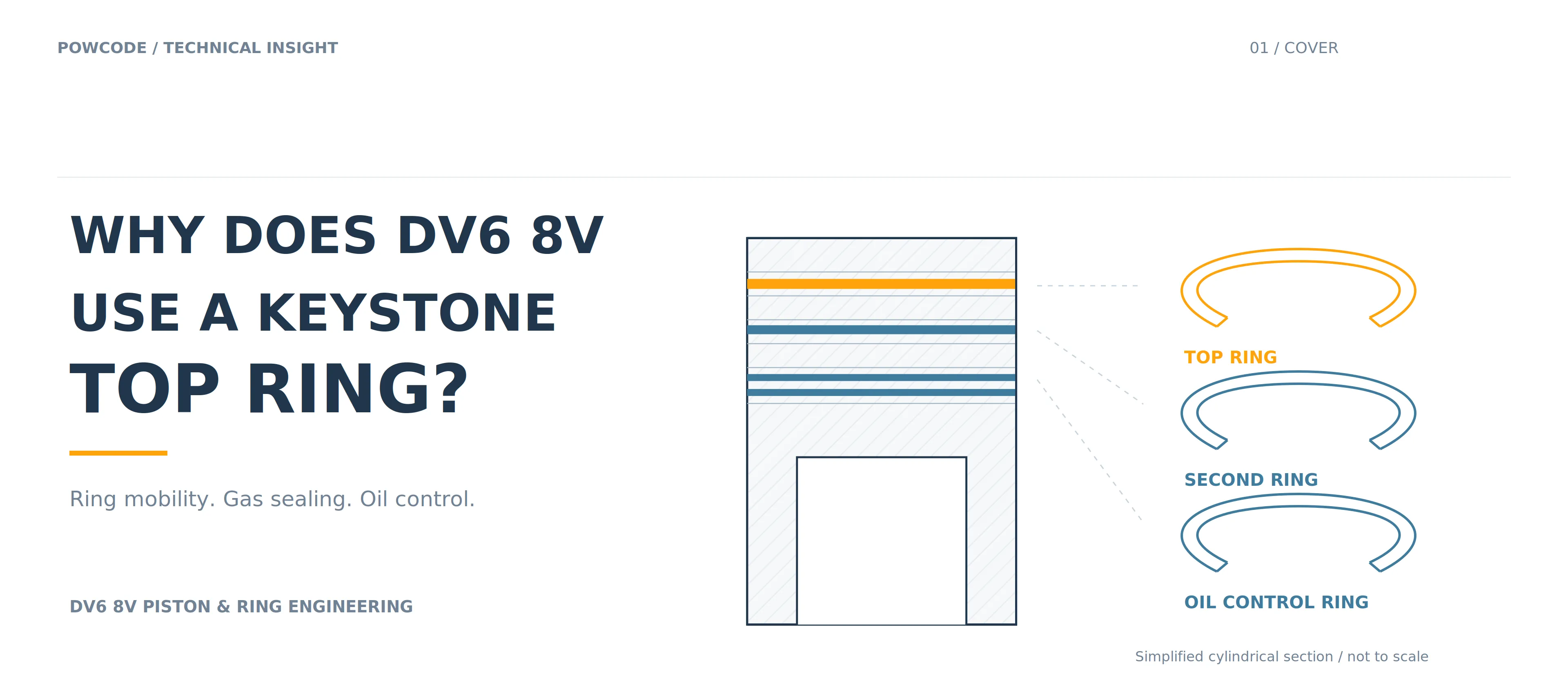
The top ring sits closest to the combustion chamber. It is exposed to hot gases and forms the first barrier against combustion-gas leakage into the crankcase. Oil in the groove can coke at high temperatures, while soot from combustion also enters this area. As deposits accumulate, they restrict ring movement and can eventually cause the ring to stick in its groove.
A piston ring needs room to move. The piston rocks slightly as it travels through the cylinder, and the ring must adjust its position to maintain contact with the cylinder wall. Sticking restricts that adjustment and makes it easier for gases to pass the sealing surfaces.
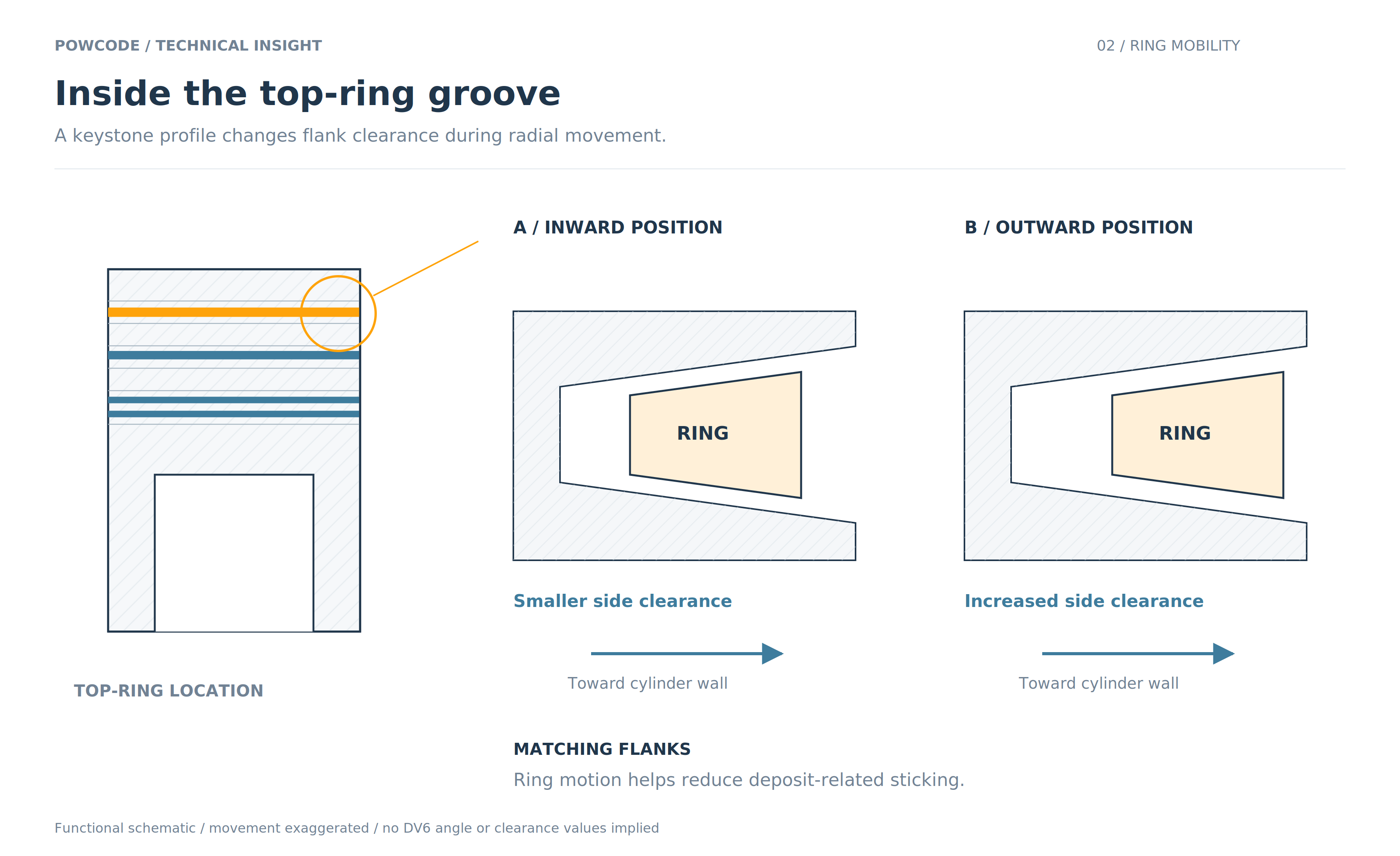
A keystone ring and its matching groove have sloped flanks. As the ring moves radially within the groove, the side clearance changes. Relative movement between the ring and groove flanks helps limit deposit accumulation and reduces the risk of sticking. This is an important technical reason for using keystone compression rings in diesel engines.[1][2]
Here, “keystone” describes the geometry of the ring's side faces across its section. It does not simply mean a chamfer on an edge. The ring requires a matching keystone groove. A rectangular ring and a keystone ring cannot be treated as interchangeable just because their bore diameter and nominal axial height are the same.
Ring mobility supports two sealing contacts
The ring's own tension presses it toward the cylinder wall, and combustion pressure reinforces that contact. Gases enter the groove and act behind the ring, while also pressing the compression ring against the lower groove flank. Sealing therefore depends on both the ring's outer face contacting the cylinder wall and its side face seating against the groove.[1]
The keystone geometry allows movement, while the angle, flatness and wear condition of the matching groove determine whether the ring seats correctly. In a worn groove, a new ring may make uneven contact, twist or flex, and in severe cases break.
This is why POWCODE studies the fit between components during piston-assembly development. We purchase large quantities of actual engines and component samples for dismantling, measurement and comparison. Our assessments of product dimensions and structures are grounded in this physical research. For pistons and rings, recording individual dimensions is only part of the work: the relationship between the ring section and groove geometry also needs to be checked.
Measurement conditions are particularly important for keystone rings. Their radial position differs between the free state and the state in which they are compressed to cylinder diameter, and the side clearance changes accordingly. A feeler-gauge reading taken with the ring sitting uncompressed in the groove cannot therefore be treated directly as its operating side clearance.[2]
How the three rings work together
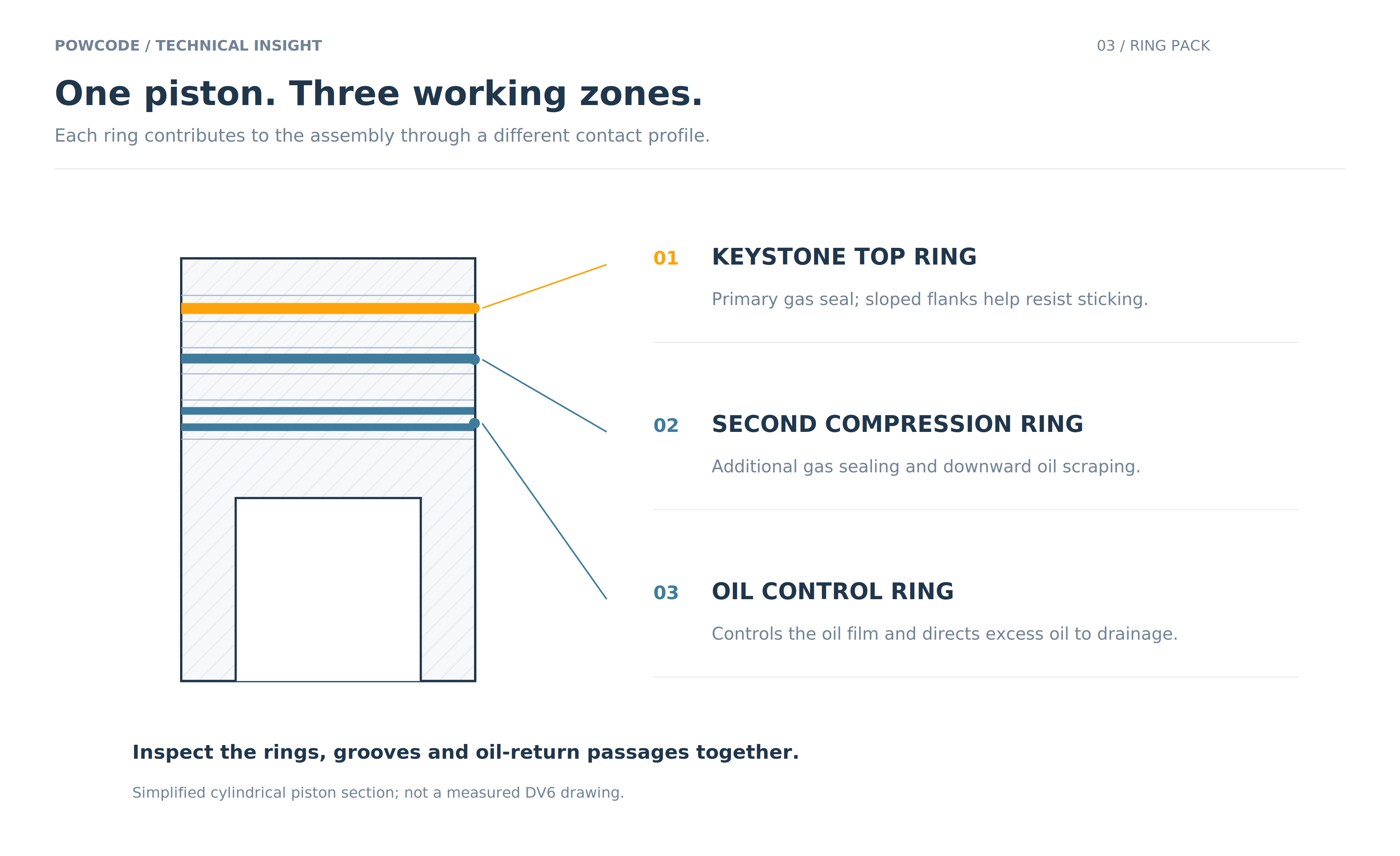
A mobile top ring can continue to provide the primary gas seal. Below it, the second ring and oil control ring connect gas sealing with oil management. Each occupies a different position and has a different emphasis, while the performance of the complete ring pack depends on its fit with the grooves, cylinder wall and oil-return structures.
The second ring contributes to gas sealing and oil scraping. On the downward stroke, it helps scrape excess oil down the cylinder wall, reducing oil migration toward the combustion chamber. It receives less combustion-pressure assistance than the top ring, so its scraping performance is affected by operating conditions. At idle and part load, lower pressure behind the ring can reduce the second ring's oil-scraping effectiveness in certain engines.[2][3]
The second ring's section and installation direction should be checked together. Features such as a tapered running face or an internal chamfer affect cylinder-wall contact and the ring's working attitude. The published catalogue for the DV6C ring set includes a second-ring section drawing for that particular application. For an earlier DV6 16V assembly, check the drawing and markings for its matching ring set rather than transferring the DV6C profile or fitting direction to it. Installation direction must follow the ring markings and supplied instructions. It should not be reversed based on appearance, and a Napier-profile ring used in another engine should not be assumed to describe this application.[2][6]
The oil control ring sits below the compression rings. Its main task is to control the amount of oil on the cylinder wall: it removes excess oil while leaving a lubricating film for the piston and rings. Scraped oil must then pass through the ring's drainage spaces and the piston oil-return holes or slots toward the piston interior. Inspection should therefore cover the working surfaces and ring tension as well as the condition of the return passages.[2]
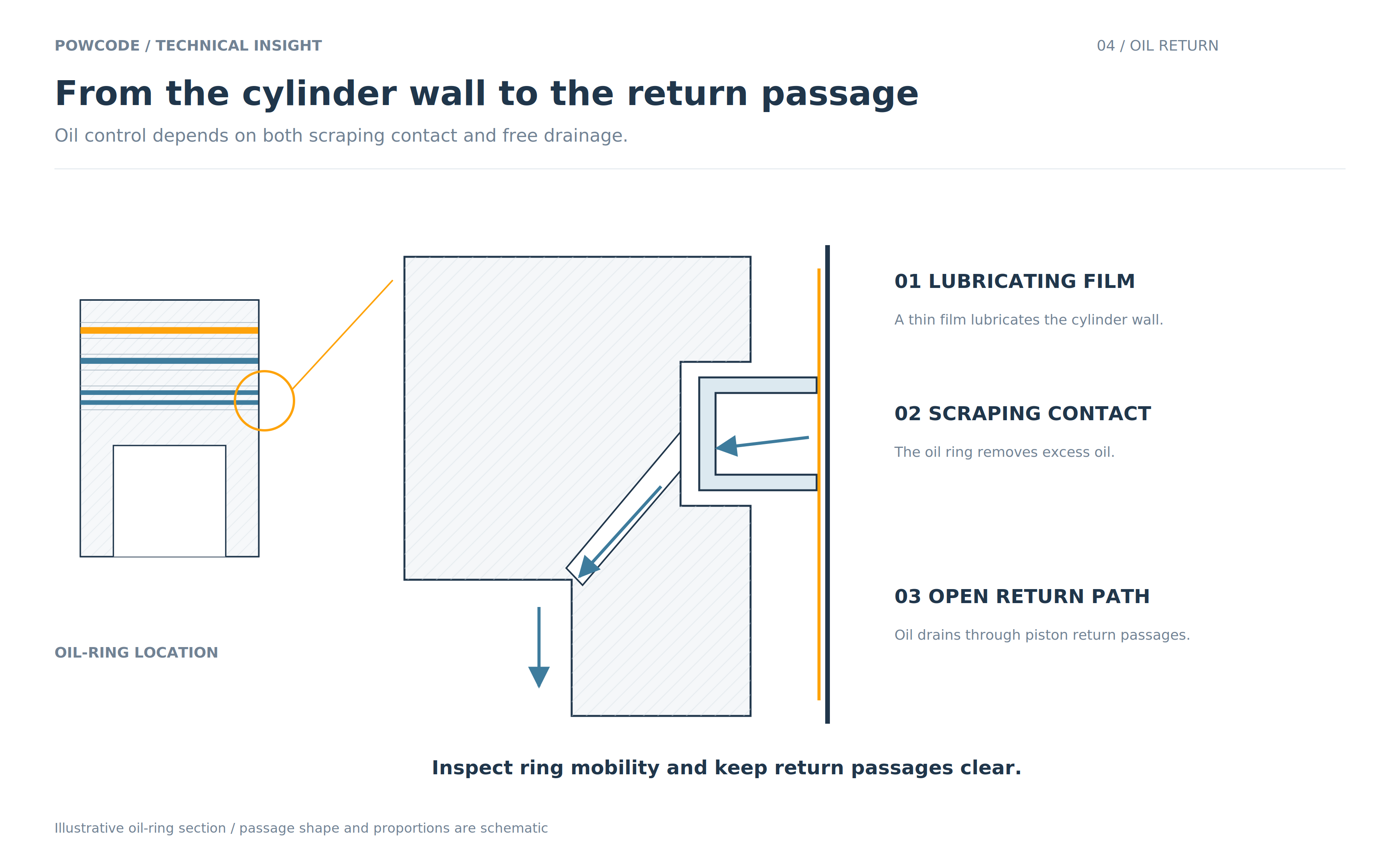
The oil-ring construction must be confirmed for the matching ring set; a three-piece design should not be assumed for every DV6 8V or 16V version. Blocked return passages, a stuck oil ring or poor contact can leave excess oil on the cylinder wall. A correctly functioning top ring cannot take over the oil ring's job.[2]
These functions define what a piston-assembly sample comparison needs to cover: the top ring and keystone groove, the second ring's section and installation direction, and the relationship between the oil ring and return passages. POWCODE's dismantling, measurement and comparison of engines and component samples provide physical evidence for assessing these structures and dimensional relationships. They also explain why the same “smaller is better” rule cannot be applied to every clearance in the ring pack.
Why ring clearances should not simply be minimised
A ring needs to contact its sealing surfaces while retaining space for movement, thermal expansion and gas-pressure loading. Several different clearances are involved: the end gap between the ring ends, the side clearance between the ring and groove flanks, and the back clearance between the ring's inner surface and the groove root. They serve different purposes and require different checks.
A visibly larger end gap does not automatically mean that the ring is incorrect or will cause excessive oil consumption. Some engines are designed with larger compression-ring end gaps so that pressure acts behind the ring more quickly, improving scraping and sealing under particular operating conditions.[3]
This principle shows why ring clearances must be understood as part of the complete assembly. It is not a repair instruction to enlarge a DV6 8V or 16V ring end gap. The applicable limits must still be checked against the specific engine version and matching component requirements.
Ring movement also has limits. Loss of stable contact impairs sealing: axial flutter lifts the ring away from the lower groove flank, while radial collapse causes loss of contact with the cylinder wall. The cited technical discussion focuses particularly on petrol engines at medium load and high speed; it does not establish this as a common fault in DV6 8V or 16V engines.[4] The relevant lesson is that a ring needs both freedom to move and reliable sealing contact.
Controlling temperature and wear around the groove
A keystone ring helps address deposit-related sticking, but it cannot compensate for abrasive contamination. Dust entering through the intake system, or contamination left in the lubrication system after repair, can reach the grooves and mix with oil to form an abrasive paste. As the ring and piston move, the ring flanks wear and the groove widens, changing the original fit.[5]
When blow-by or abnormal oil consumption occurs, inspection should include the grooves, cylinder wall, intake filtration and repair cleanliness. Replacing rings while continuing to use worn grooves may leave the sealing problem unresolved.
The top-ring groove also withstands sustained thermal loading and mechanical contact. A published DV6C piston catalogue lists a ring carrier and an internal cooling gallery.[6] Ring carriers improve wear resistance around the groove, while cooling galleries use circulating oil to remove heat from the piston and ring-belt region.[7]
The cited DV6C example documents those features for that piston; their construction and dimensions must be checked on the selected 16V piston as well. These features work alongside the keystone ring to address the conditions around the top groove. The sloped section supports ring mobility, the groove structure withstands contact and wear, and cooling controls thermal loading. Selecting components by bore diameter alone can overlook these important relationships.
Selecting piston rings for DV6 8V and 16V assemblies
Separate catalogue listings show why the engine version matters. The DV6C piston example is paired with ring set 06-838300-00-STD, while the earlier DV6 TD / TED piston example lists ring set 06-889000-00-STD. These are application-specific catalogue references, not a statement that the two sets are interchangeable.[6][8] The common operating principles explain what to inspect; the matching component specification determines which rings to order.
In DV6 8V and 16V assemblies equipped with a keystone top ring, the sloped profile helps maintain gas sealing by reducing sticking risk. The second ring contributes to sealing and scraping, while the oil ring works with the return passages to control cylinder-wall oil. All three depend on matching grooves, correct assembly and a clean operating environment.
POWCODE bases its development work on dismantling, measuring and comparing actual engines and component samples so that these fit relationships can be considered in specific products. When sourcing pistons, ring sets or complete assemblies, check the engine version, original component structure and matching specifications. Reusing a piston also requires an assessment of groove condition.
For 8V applications, explore the related components on the POWCODE DV6 8V engine parts platform. For DV6 16V requirements or a ring-and-piston specification check, contact POWCODE with the engine code, OE reference and clear photographs of the original piston, grooves and rings. Identify the required engine version when requesting pistons, ring sets or complete assemblies.
References
These sources explain general operating principles and document specific aftermarket product structures. General engineering explanations are not presented as an original DV6 8V or 16V development statement. The cited product examples retain their specific application scope.
- Goetze. Taper sided (keystone wedge) piston grooves — SB2123.1. Keystone grooves, sticking resistance and worn-groove fit.
- Motorservice. Piston rings for combustion engines. Ring profiles, keystone-ring operation and clearance assessment.
- Motorservice. Piston ring joint clearance and oil consumption. End gap, pressure behind the ring and oil consumption.
- Motorservice. Sealing problems and piston ring damage — Ring flutter. Axial flutter and loss of radial contact.
- Motorservice. Sealing problems and piston ring damage — Dirt. Contamination-related ring and groove wear.
- Federal-Mogul. DV6C piston 87-72772-STD / ring set 06-838300-00-STD. Ring-pack and piston features for a specific DV6C aftermarket application.
- MAHLE. Light Vehicle Pistons. General information on ring carriers and piston cooling structures.
- Federal-Mogul. DV6 TD / TED piston 87-71783-STD / ring set 06-889000-00-STD. Separate catalogue application for the earlier DV6 piston and ring assembly.